
1. The Challenge: A Handle That Couldn’t Hold
For years, our standard flight case handle reliably supported 50kg+ loads (zinc-plated version). But when a customer requested a longer version (black, same 316L stainless steel), it failed under just 50kg—despite identical material quality.
2. The Mystery: Why Did It Fail?
The customer insisted on unchanged dimensions (due to fixed case space) and blamed the material—but 316L/V4A stainless steel wasn’t the issue. Our engineers discovered the real culprit: structural physics.
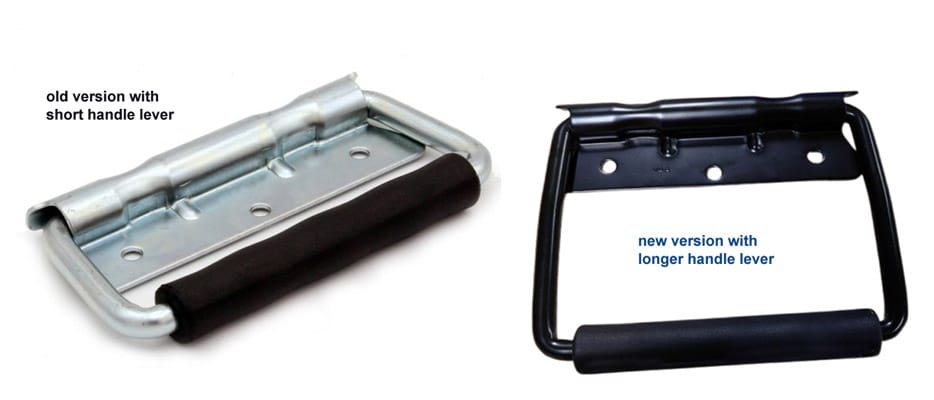
3. The Physics Behind the Failure
- Lever Effect: A longer handle increases torque on mounting points.
- Stress Distribution: The original design’s load capacity relied on shorter leverage; extra length multiplied force unevenly.
- Material ≠ Structure: Even premium steel fails if forces aren’t properly distributed.
4. The Fix: Engineering Under Constraints
With no dimension changes allowed, we:
- Reinforced Weak Points: Added internal bracing near mounts.
- Redistributed Load: Adjusted handle curvature to balance stress.
- Tested Iteratively: Simulated loads until it held 50kg+ safely.
5. The Lesson: Design Beyond Materials
- Physics First: Material strength alone won’t compensate for poor leverage.
- Ask Critical Questions: Always clarify real-world load conditions upfront.
- Prototype Early: Test extended designs under max stress before production.
6. Your Turn – Can You Solve It?
